Beyond HTTP Polling: The Real-Time Imperative
Modern users expect live collaboration: whether editing documents, adjusting audio faders, or tracking geospatial vehicle locations. If two users edit the same entity and updates take 500ms to propagate, conflicts multiply exponentially.
To achieve an imperceptible round-trip latency (< 20ms), the entire stack must be redesigned around persistent duplex bi-directional streams.
The Distributed Multi-Node Dilemma
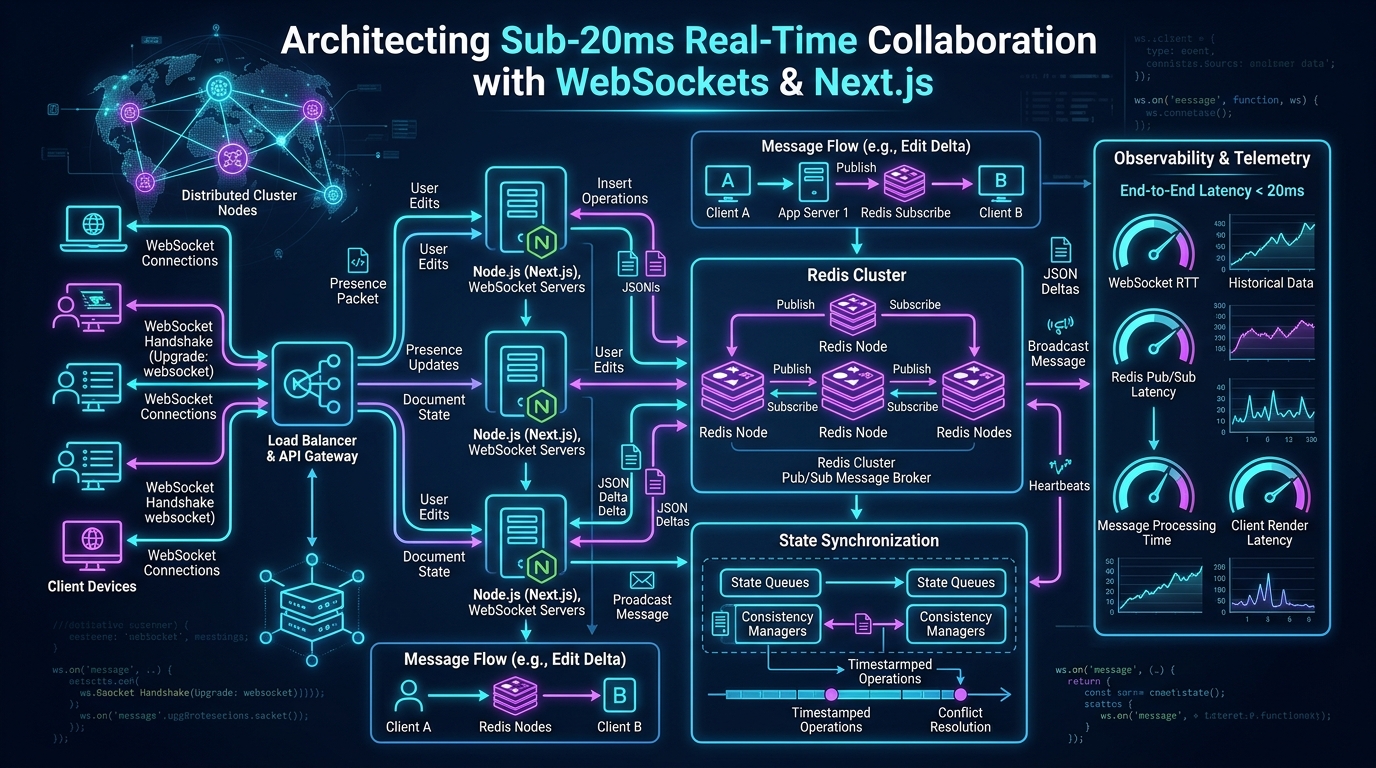
On a single Node.js instance, managing WebSockets is straightforward: keep an array of active client sockets in memory and broadcast events. But what happens when you scale horizontally across multiple instances or serverless edge clusters?
Client A is connected to Server Node 1 in Frankfurt; Client B is connected to Server Node 2 in Amsterdam. When Client A modifies a canvas object, Server 1 cannot directly write to Server 2's socket descriptors.
// Distributed Redis Adapter for Socket.IO / WebSockets
import { createClient } from 'redis';
import { createAdapter } from '@socket.io/redis-adapter';

const pubClient = createClient({ url: process.env.REDIS_URL });
const subClient = pubClient.duplicate();

await Promise.all([pubClient.connect(), subClient.connect()]);
io.adapter(createAdapter(pubClient, subClient));
Conflict-Free Replicated Data Types (CRDTs)
Traditional lock-based databases fail in high-throughput collaborative sessions because network latency will lock the document for one user while another is typing.
By implementing State-based or Operation-based CRDTs (using algorithms like Yjs or Automerge), operations are commutative and idempotent. Even if network packets arrive out of order, all distributed client nodes converge to the exact same state deterministically without locking.
Combining persistent WebSocket connections with Redis Pub/Sub backbones yields a resilient, high-speed collaboration engine capable of handling tens of thousands of concurrent real-time events.