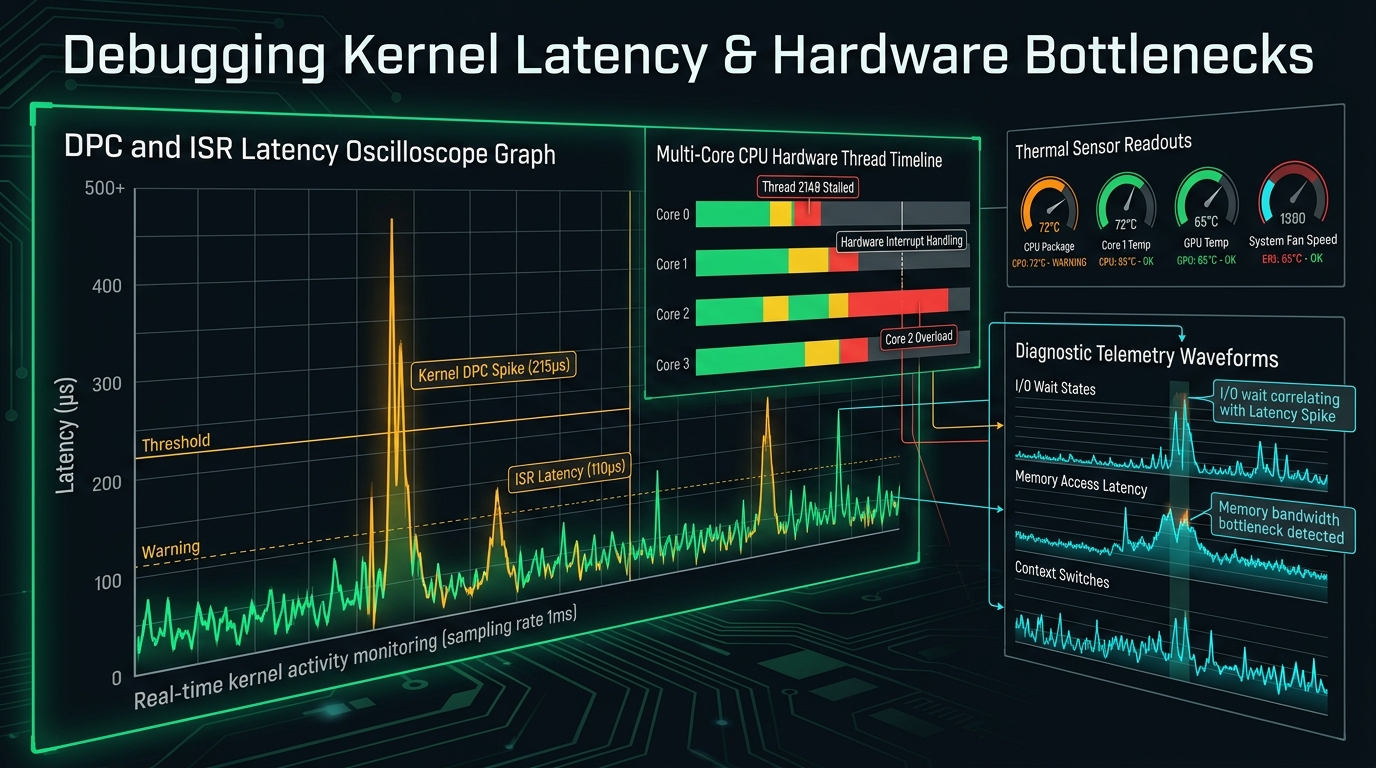
The Illusion of 0% CPU Load
Most software developers rely on standard operating system task managers. If CPU usage shows 8% and memory is plenty, they assume the machine is operating with zero bottleneck. But for real-time systems—whether you are streaming high-fidelity lossless audio, executing high-frequency trading algorithms, or rendering 240Hz physics simulations—throughput is not latency.
A single misbehaving hardware driver executing a Deferred Procedure Call (DPC) or Interrupt Service Routine (ISR) can monopolize a CPU core for 500 microseconds. To the human eye, that is a sudden dropped frame, an audio pop, or a mouse micro-stutter.
Understanding the Hardware Interrupt Hierarchy
When peripheral hardware (like an NVMe SSD controller, GPU PCIe link, or USB host controller) needs immediate servicing, it triggers a physical hardware interrupt (IRQ):
- Interrupt Service Routine (ISR): Executes at elevated IRQL (Interrupt Request Level). It halts normal OS scheduling, performs the bare minimum required to acknowledge the device, and queues a DPC.
- Deferred Procedure Call (DPC): Runs at IRQL DISPATCH_LEVEL. It completes the heavy lifting (copying buffers, updating pointers).
If a faulty Wi-Fi driver or graphics bus takes more than 250 microseconds in a single DPC callback, other critical threads are starved. The kernel's real-time scheduler loses determinism.
# Diagnostic commands for kernel latency tracing
wpr -start Latency -filemode
# Reproduce the stutter issue...
wpr -stop latency_trace.etl
wpa latency_trace.etl
Tracking the Culprits with Windows Performance Analyzer (WPA)
By capturing Event Tracing for Windows (ETW) with high-precision timestamp counters (RDTSC), we can map every microsecond of execution. Common real-world root causes include:
- Power State Transitions (C-States & D3Cold): When PCIe bus links drop to low-power link states, waking them up introduces up to 100μs exit latency.
- Storage Controller Stalls: Misconfigured SATA/NVMe link power management causes queue timeouts under bursty asynchronous writes.
- Interrupt Affinity Clustering: By default, multiple high-throughput devices can get mapped to Core 0. Reassigning MSI-X vectors across dedicated performance cores immediately flattens the latency curve.
Diagnosing at the bare-metal level is what separates surface-level engineers from genuine hardware power users.