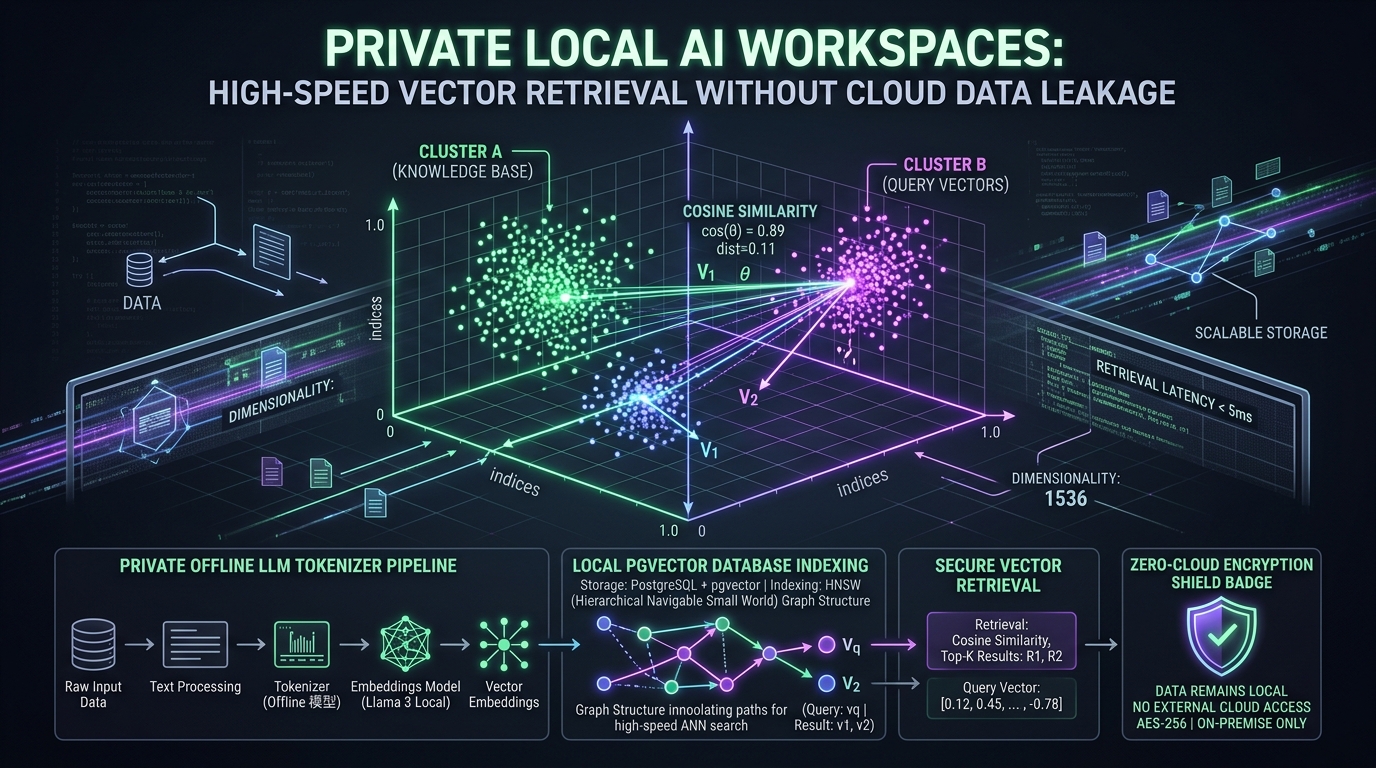
The Privacy Problem with Cloud AI APIs
The promise of Retrieval-Augmented Generation (RAG) is immense: connect your proprietary codebase, CAD schematics, and internal documentation to an AI model that answers queries with context. However, sending proprietary source code or legal agreements across public APIs exposes organizations to severe data compliance and confidentiality risks.
The modern engineering solution is Local AI Workspaces: running localized embedding models and private vector indexes directly on internal infrastructure.
High-Dimensional Vector Math in PostgreSQL
Text embeddings convert semantic phrases into high-dimensional floating-point vectors (e.g., 1536 dimensions). Similarity is computed via Cosine Distance or Inner Product:
-- Create the vector extension and table with pgvector
CREATE EXTENSION IF NOT EXISTS vector;

CREATE TABLE document_embeddings (
  id BIGSERIAL PRIMARY KEY,
  document_id VARCHAR(64) NOT NULL,
  content TEXT NOT NULL,
  embedding vector(1536)
);

-- Create Hierarchical Navigable Small World (HNSW) index
CREATE INDEX ON document_embeddings
USING hnsw (embedding vector_cosine_ops)
WITH (m = 16, ef_construction = 64);
Why HNSW Beats Traditional Exhaustive Search
Calculating cosine similarity across 500,000 document vectors sequentially requires millions of floating-point dot products (O(N) complexity), taking seconds per query. HNSW (Hierarchical Navigable Small World) graphs structure the vector space into multi-layer geometric graphs.
- Higher layers provide long-distance jumps across semantic clusters.
- Lower layers perform fine-grained nearest-neighbor convergence.
This reduces retrieval time from 1,800ms down to sub-5 milliseconds, enabling instant semantic search completely offline on local machines with zero data ever leaving the host.